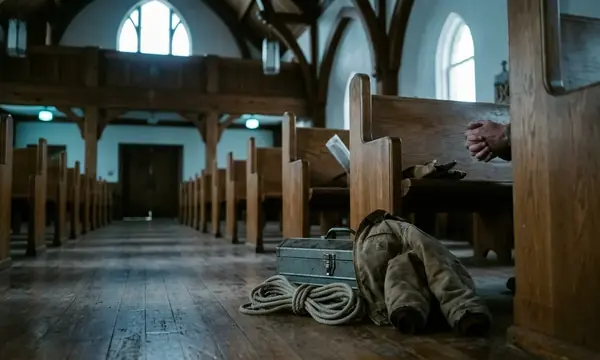

Success Ends Where Succession Stops
Leaders who fail to reproduce themselves build a terminal generation. The ministry may retain its schedule, attendance, and public energy for years, yet its accumulated spiritual vitality dies when the central leader leaves.
Sustainable church leadership therefore requires two commitments at the same time: wholehearted obedience in the present and intentional succession for the future. Total commitment keeps a leader aligned with the mission. Spiritual parenthood prepares another person to receive responsibility, authority, and eventually the mantle of leadership.
Jeremy Haroldson developed these themes across two teaching arcs. The reproduction messages began with “The Dead Sea Syndrome” on May 1, 2022, followed by “The Mantle of Leadership” on May 15. The commitment messages came nine months later: “The Commitment Gap” on February 19, 2023, and “Burn the Ships” on March 5. Each pair came two weeks apart.
Taken together, the four sermons make one demanding claim. Leadership capacity is measured by more than what a person can accomplish alone. It includes the people that leader prepares to carry the work forward.
The Blank-Successor Test
If Sunday attendance holds steady or grows while no one can answer, “Who is being trained to receive the mantle here?” the ministry is spending inherited capital rather than depositing it.
I have found that this question changes the conversation quickly. Reports about activity give way to names, responsibilities, and actual preparation. An unnamed hope is not a succession plan. A faithful leader should be able to point toward someone who is learning how decisions are made, how people are cared for, and how authority is carried without grasping for it.
Partial Obedience Leaves the Mission Exposed
What exactly makes obedience partial? Haroldson’s February 19, 2023 message, “The Commitment Gap: Stop Trying, Start Deciding,” gives the term an observable meaning. Partial obedience occurs when a directive is followed except at a particular point of retained control.
First Samuel 15 supplies the case. Saul carried out much of the command, yet he retained the best livestock and kept the captured king alive. When confronted, he offered three successive explanations. The problem was concrete: Saul preserved exceptions that the command did not grant him.
This definition matters because “half-hearted” describes a feeling that another person cannot reliably assess. Retained livestock can be counted. A spared king can be seen. In church leadership, the same pattern appears when a leader agrees with the mission while quietly protecting one relationship, habit, budget preference, or area of authority from its demands.
Approval Can Become a Rival Authority
Saul eventually acknowledged that he feared the people and listened to their voice. The fear of man had become a rival chain of command. Peer approval carried greater practical weight than the mission entrusted to him.
Transactional leadership grows from this divided loyalty. The leader obeys while obedience produces recognition, cooperation, or visible progress. When the cost rises, commitment becomes negotiable. Total commitment settles the controlling question beforehand: What has God required, and what faithful action follows from that requirement?
The contrast with David is instructive. Second Samuel 12 and Psalm 51 preserve an unqualified admission of sin. David’s failures were grave, but his response to confrontation did not depend on a sequence of self-protective explanations. Saul kept trying to manage the verdict. David confessed.
The consequence for Saul arrived in the same conversation: the kingdom was torn away. A single protected exception ended the future of a family line that had held the throne for roughly four decades. That is the leadership danger of partial obedience. The exception often looks small from inside the decision, while its succession cost becomes visible only later.
A Vow Removes Tomorrow’s Escape Route
Leaders commonly ask how to sustain commitment when energy drops and ministry demands collide. The practical answer in “Burn the Ships: Why Total Commitment is Easier Than Partial Effort,” preached March 5, 2023, is the vow.
A vow is a solemn promise to perform a specified act. It intentionally surrenders future optionality. Numbers 30:2 and Ecclesiastes 5:4-5 treat such promises with gravity because words spoken before God create an obligation that mood does not erase.
This has a direct effect on decision fatigue. A leader who has never settled basic boundaries must reopen the same questions whenever pressure rises. Will alcohol be part of this setting? Who may ride alone in the vehicle at night? Which meeting yields when the calendar collides? Repeated evaluation consumes attention and gives convenience another opportunity to rewrite conviction.
A carefully formed vow turns those questions into settled policy. The mind can then spend its limited attention on pastoral care, preparation, and the genuinely new problems of the day.

Put the Commitment on a Calendar
- Write one sentence. Name the act or boundary precisely enough that two people could agree on whether it was kept.
- Date the commitment. A date separates a decision from a recurring intention.
- Speak it to two witnesses. Give them permission to ask direct questions about your follow-through.
- Review it every 90 days. Use a fixed cycle rather than waiting for conviction to resurface during a crisis.
The quarterly review does not make the promise temporary. It creates a scheduled point for examining practice, repairing drift, and clarifying application. A vow should reduce needless reconsideration without becoming a substitute for wisdom. Define the boundary carefully, then honor it when keeping it becomes inconvenient.
Authority Without an Outlet Turns Sterile
The Dead Sea receives water continuously from the Jordan, yet it has no outlet. Evaporation leaves salinity hovering around 34 percent, roughly ten times that of ocean water, and fish cannot live there. Haroldson used that geography in his May 1, 2022 teaching to describe a ministry that receives resources, teaching, trust, and authority while releasing none of them through developing leaders.
The resulting Dead Sea Syndrome is organizational stagnation. One person becomes the route for every decision. Volunteers carry tasks but never gain judgment. Emerging leaders receive information without meaningful authority. A senior leader may appear indispensable, which can feel like evidence of effectiveness until absence exposes the weakness.
Look for Blocked Outflow
- Routine decisions return to the same leader even after someone else has been assigned the work.
- Potential leaders receive instructions but rarely hear the reasoning behind them.
- Delegated authority disappears as soon as a choice becomes uncomfortable.
- No one practices leading a meeting, resolving conflict, or caring for people while supervision is still available.
- Succession remains a future discussion without a named person or development term.
A terminal generation consumes what previous believers built without preparing the next generation to receive it. The pattern can exist in a congregation, a youth program, a recovery ministry, or a small discipleship group. Scale changes the number of people involved; it does not change the underlying mechanism.
Diagnosis requires care in rural ministry. A church serving a county with a population hovering around 9,000 may have a genuinely thin volunteer bench rather than a leader who blocks every outlet. Those conditions call for opposite responses: recruitment for the first, deliberate release of authority for the second.
Self-assessment also has limits here. A leader who has served as the single decision point for years may no longer notice how work is routed. An honest reading may require a sectional presbyter, a pastor from another town, or a board member who has explicit permission to answer without diplomacy. The useful question is specific: Where does responsibility return to me after I have supposedly released it?
Choose Spiritual Children Through the FAITH Screen
The answer to organizational sterility is spiritual parenthood: relational discipleship that gives another person access to a leader’s doctrine, judgment, habits, correction, and responsibility. Paul the Apostle describes many instructors but few fathers in 1 Corinthians 4:15-17, then points to Timothy as a faithful child who can be sent to remind the church of Paul’s ways.
That sending matters. Spiritual parenthood aims toward mature participation, not permanent observation. The body imagery of 1 Corinthians 12 reinforces the principle. Each member receives a place in the body’s life, and healthy leadership helps members exercise their gifts in ordered service to one another.
“Mentor someone” remains too vague to guide selection. The FAITH criteria turn the invitation into a disciplined judgment based on observable conduct.
Five Behaviors Worth Watching
- Faithful: The person follows through across ordinary weeks, including tasks that bring little recognition.
- Available: The person makes room for service when participation becomes inconvenient.
- Intentional: The person acts with purpose, asks what preparation is needed, and takes responsibility for the next step.
- Teachable: The person receives correction, applies it, and returns with evidence of growth rather than defensiveness.
- Hungry: The person seeks deeper formation and useful responsibility without demanding a title.
Watch for these behaviors over six to eight consecutive weeks before extending an invitation. Include at least one holiday weekend and one poor-weather Sunday. Availability is easiest to claim when the calendar is clear; inconvenience reveals whether the pattern is real.

Begin with a defined 90-day trial. State what you will practice together, how often you will meet, and which responsibility the mentee will begin carrying under supervision. If the relationship bears healthy fruit, move into a full cycle of nine to twelve months. Most leaders should limit this work to two or three mentees at once because spiritual parenthood requires attention, correction, prayer, and real access.
Formation Before Position
The FAITH screen selects people to father, not people to credential.
The framework carries no authority over Assemblies of God ministerial credentialing, background screening for people serving youth or recovery participants, or board approval of paid staff. A person may meet all five criteria and still be unready for a key, a title, or unsupervised access. Spiritual formation and institutional authorization answer different questions, and faithful churches honor both.
Advanced succession begins when the mentee receives work with consequences while the parent remains close enough to coach. Let the person plan part of a service, lead a bounded conversation, or care for a family with clear reporting expectations. Responsibility develops judgment when feedback follows quickly and correction remains relational.
Place the Mantle on a Named Shoulder
Haroldson’s May 15, 2022 message, “The Mantle of Leadership,” closes the reproduction arc with Elijah and Elisha. In 1 Kings 19:19-21, Elijah crosses a field and casts his mantle over Elisha at the plow. The garment represents office and authority. Elisha then destroys the equipment that would have preserved an easy return to his former life.
Later, in 2 Kings 2:9-14, Elisha asks for a double portion and recovers Elijah’s mantle at the Jordan. The request draws on the firstborn inheritance provision in Deuteronomy 21:17. Elisha seeks the capacity required to carry the inherited assignment forward. He receives an identifiable responsibility, then acts with it.
This is where commitment and succession meet. The mentor must release authority rather than clutch it. A successor must close the escape route and accept formation. Neither person can complete the transfer through admiration alone.
Your Seven-Day Assignment
- List every person currently within your sphere of influence.
- Mark those who demonstrate all five FAITH criteria.
- Select one person rather than leaving the choice open.
- Book a 45-to-60-minute conversation within the next seven days.
- During that conversation, name the behaviors you have observed and propose one specific 90-day discipleship commitment.
Open your calendar now, choose the meeting time, and send that invitation before another Sunday passes.