Faith-Based Roots in Platte County
Platte County covers roughly 2,100 square miles and holds fewer than 9,000 residents. That leaves a population density of about four people per square mile. Any support model assuming walk-in density struggles in this environment. Formal clinical infrastructure arrived late and remains thin. The nearest metropolitan behavioral-health campuses sit 70 highway miles south and roughly 100 miles northwest. Long before standardized curriculums existed, congregational and lodge-hall support structures operated in the Wheatland area, dating back to the 1890s irrigation-settlement period.
For residents of Wheatland and the surrounding areas, the primary backbone for addiction and life-struggle support is the integration of local church ministries and the Celebrate Recovery framework. The system leans on peer accountability, biblical principles, and consistent weekly engagement. Drawing on pastoral intake conversations gathered over several years, a clear pattern of community reliance emerges. People need immediate, accessible community.
Thursday Night Meeting Mechanics
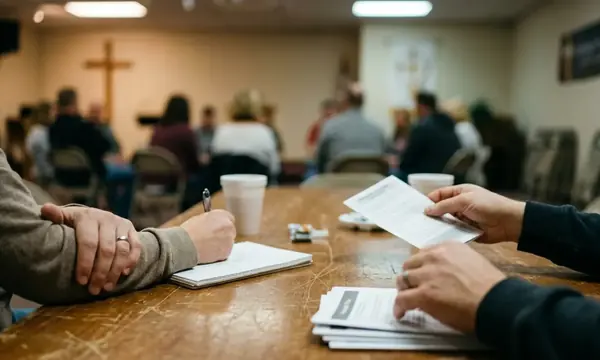
A standard weekly evening runs about two hours and fifteen minutes. The night opens with roughly 20 minutes of worship, followed by a 30- to 40-minute teaching lesson or a single personal testimony. After a short break, attendees move into 55 to 60 minutes of gender-separated small groups. Closing out the evening is an informal coffee-and-dessert fellowship window of 20 to 30 minutes. Newcomers receive a 15- to 20-minute orientation before their first small group, so they understand the format and feel comfortable passing without explanation.
Navigating Small Group Rules
Small groups operate under five fixed ground rules. The most consequential is the strict rule against cross-talk. Participants speak in the first person, and listeners remain quiet without advising or attempting to fix another person's share. Sharing time is capped at three to five minutes per person so an eight-to-twelve-person circle finishes on time.
For deeper work, Step Studies require a separate commitment on a different night. A closed cohort of the same six to ten people works through four sequential participant guides covering 12 steps and eight principles. A full cycle typically takes 46 to 52 weeks. These groups close to new members after the first two or three meetings so the cohort completes the journey together.
A volunteer group leader with a participant guide provides strong peer accountability and spiritual formation. They lack the medical training to supervise withdrawal from alcohol or benzodiazepines, manage acute psychiatric crisis, active psychosis, or suicidal intent. Those acute medical situations belong with the 25-bed critical access hospital in Wheatland, a physician-supervised detox setting, or the 988 line. The weekly group serves as the aftercare that catches someone on the other side of medical stabilization.
Integrating Family Support Tracks
Single parents and couples with school-age children often face logistical hurdles when seeking help. Without childcare on a weeknight, attending a meeting becomes nearly impossible. To solve this, three tracks run concurrently in one building during the same two-hour block. The adult meeting happens alongside a teen track for ages 13 to 18 and a children's track for ages 5 to 12. Each room has its own leaders. Dedicated volunteers handle all childcare duties that evening.
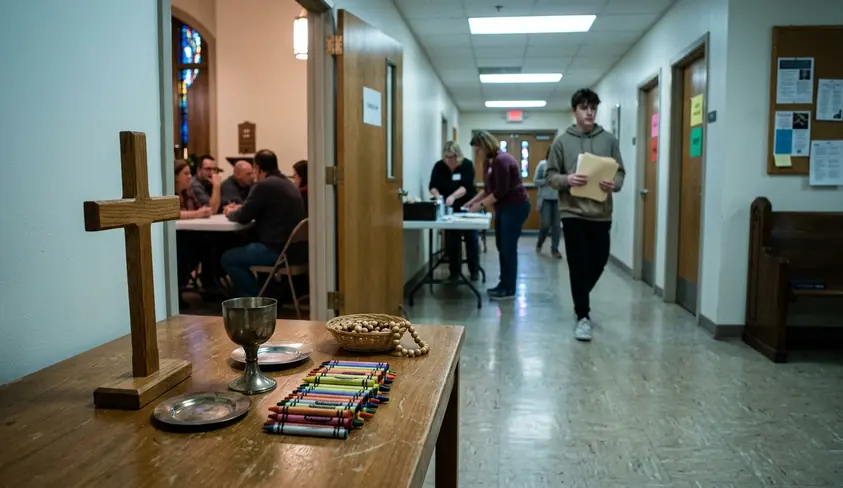
This single-hub arrangement eliminates a second trip for outlying families. One-way drives from Chugwater run about 23 miles, and trips from Glendo take about 28 miles. Families coming from Guernsey and the Hartville area drive roughly 30 to 35 miles. A split-location model would add 45 to 70 minutes of driving to an already long weeknight.
Volunteer coverage works best on a four- to six-week rotation. That prevents leader burnout and ensures a participant who is 60 to 90 days into their own recovery is never the sole adult in a children's room. Leaders track a simple retention marker: whether a household returns for a fourth consecutive week. At that point, small-group familiarity typically overtakes first-visit anxiety. Pastor Jeremy Haroldson frequently emphasizes how different parts of a community must support one another. Much like the teachings of Paul the Apostle in 1 Corinthians 12, every distinct function works together to sustain the whole body. Accessing rural behavioral health resources often requires this kind of coordinated, multi-generational effort.
Sustaining Rural Accountability Networks
Sustained rural impact requires a timeline measured in years. A group surviving its first 18 to 24 months typically produces its own next generation of leaders from among earlier Step Study graduates. That is how small-town programs outlast their founding volunteers. The framework also functions as a portable credential for accountability. Sponsors and accountability partners use the same terminology and guide numbering, so a relationship formed locally can continue by phone during a six- to nine-month seasonal work absence.
The curriculum originated at a Southern California congregation in 1991 and has been in continuous use for more than three decades. Today, Celebrate Recovery runs in something on the order of 35,000 churches worldwide, with several million participants having worked through the standardized materials.