Defining the Wheatland Ministry Pillars
How can a local church connect spiritual leadership with practical community needs in Wheatland? Pastor Jeremy Haroldson approached this by working backward from the existing church calendar. The planning cycle ran across roughly nine months, from late-summer board sessions through the spring calendar reset. Leadership used monthly review checkpoints to track progress.
They sorted these events into categories of people coming to the building versus the church going to the neighborhood. This review established three pillars—structured youth engagement, accessible recovery support, and active community integration. The Wheatland pillar test requires that a ministry survives losing any single volunteer. Each of these three areas cleared that bar by securing a named lay coordinator and a designated backup before launch. A proposed benevolence arm failed this test and was entrusted to organizations already running it weekly in town.
Structuring Discipleship for Young Residents
Expanding a youth ministry requires careful pacing. Leadership set a strict gate for growth. A new program night only opens after the existing night completes a full 12-to-13-week quarter without a leadership gap.
Every meeting maintains a minimum ratio of two cleared adults, with background checks completed well in advance, regardless of student turnout. Small discussion circles stay between six and eight students, small enough that everyone gets a chance to speak. This structure shifts the focus toward active discipleship and leadership training for young residents.
Note that this pacing model assumes a volunteer bench where each role has a trained backup. Congregations relying on one indispensable youth leader will find the quarterly gate simply stalls, and the honest fix there is recruitment before expansion. After-school and weekend blocks run roughly two hours, ending early enough for school-night curfews.
Establishing Sustainable Recovery Networks
A single pastor cannot carry weekly group facilitation, one-on-one follow-up, and Sunday preparation. Recognizing this limit, the church structured its recovery support as a lay-led ministry with pastoral oversight to keep the schedule survivable. Groups meet on a fixed weeknight using a rotating bench of two to three trained lay facilitators. No single leader carries more than roughly one session in three weeks.
The approach combines spiritual encouragement with practical, consistent accountability. Curriculum runs in defined cycles of 10 to 12 weeks, and an open-door week between cycles gives newcomers a clean entry point. That rhythm keeps the atmosphere welcoming and rooted in conservative, faith-based principles. Drawing on historical records of Paul the Apostle, the ministry distributes the weight of care across an equipped body of believers.
Activating the Congregation
Leadership noticed two common failure patterns among willing volunteers: people placed too fast who burned out inside a season, and people who attended for months without ever being asked to serve. The solution is a concrete, three-step onramp.
Aligning Spiritual Gifts The body of Christ functions best when every member finds their specific role, a principle outlined in 1 Corinthians 12.
Step 1: Initial alignment. A prospective volunteer attends a vision-casting conversation with Pastor Haroldson. This meeting helps the individual understand the specific needs of the youth or recovery programs and aligns their interests with the church's mission.
Step 2: The shadowing phase. The volunteer observes an existing community group or youth service for three consecutive weeks. Those weeks cover the full operational flow from room setup through teardown before any task is assigned. One visit shows a good night, two shows variance, and three shows the ordinary rhythm. Leadership treats skipping this shadow floor as the primary marker for a volunteer role that will fail its first quarter, regardless of the individual's willingness.
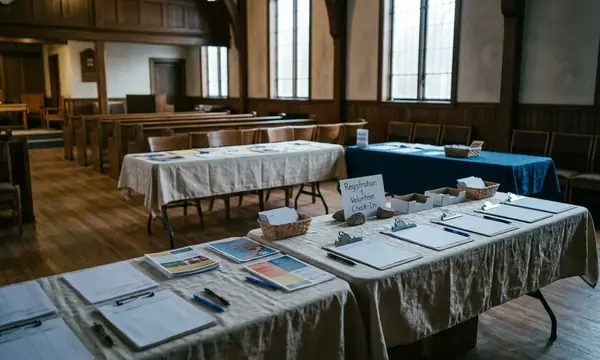
Step 3: First deployment. The volunteer takes on one narrow responsibility for an initial trial stretch of six to eight weeks. A sit-down check-in follows, where the volunteer can step back with no explanation required. In practice that looks like this: a new volunteer sits through three Wednesday youth nights, then takes the welcome table alone—name tags, sign-in sheet, greeting the students who arrive early. Seven weeks later she meets with Pastor Haroldson, says the table suits her but small-group leading does not, and stays on the door for the next quarter.