
Defining the Youth Small Group Format for Families
A youth small group is a consistent, adult-facilitated gathering of middle or high school students designed for peer fellowship, foundational Scripture exploration, and mutual support within a local church setting. For busy families across Platte County, a Wednesday or Sunday evening youth night comes down to three assurances: meetings follow a predictable, low-pressure arc of arrival games, collective worship, age-segmented discussion, and closing prayer; student safety is governed by strict multi-adult supervision protocols; and vocal participation is always voluntary.
Everything in the room is structured to bridge the gap between Sunday morning congregations and weekday life in Wheatland, Wyoming. When Jeremy Haroldson, pastor and speaker, addresses the whole church family on a Sunday, he is speaking across somewhere around four generations at once. A youth small group narrows that focus to the exact hallway, locker room, and family pressures a teenager faces between Monday and Thursday.
To keep conversations developmentally appropriate, the ministry splits students into two distinct grade bands:
- Middle School (Grades 6–8): Grouped for ages roughly 11 to 14, focusing on concrete identity, changing friendships, and foundational biblical literacy.
- High School (Grades 9–12): Grouped for ages roughly 14 to 18, tackling independent faith ownership, cultural pressures, post-graduation direction, and peer leadership.
Separating these bands prevents a sixth grader just learning how to navigate a locker combination from being dropped into a conversation with a high school senior preparing for work or college. Within both tracks, zero prior biblical knowledge is assumed. A teenager does not need to know the difference between the Old and New Testaments or own a leather-bound Bible to fit in on night one. Teaching starts from a single printed or projected passage and connects it directly to an everyday situation—handling a fallout with a teammate, dealing with academic stress, or navigating family tension.
Body Life In Practice: When Paul the Apostle wrote 1 Corinthians 12, he described the church as a living body where every distinct part belongs and no single member carries the whole weight alone. Small groups put that principle into practice at a table level, giving students a reliable circle of peers who notice when they are absent and celebrate when they succeed.
Minute-by-Minute Breakdown: From Arrival Games to Bible Discussion
Walking into an unfamiliar church building on a weeknight can feel intimidating for a teenager who does not know the unwritten rules of the room. Early in our curriculum planning, leadership considered placing small group discussion in the opening slot of the evening, reasoning that conversation is the heart of the night. That approach was set aside because a newcomer who arrives cold and is placed straight into a circle of eight peers, give or take, has had no chance to learn names or watch how the group works. Instead, the evening is ordered by how comfortable a student feels at each point in the night.
The Wheatland youth night runs in a 20–25–30 sequence, totaling 75 minutes of structured programming bookended by supervised arrival and pickup windows.
Phase 1: Arrival and Icebreaker Games (Minutes 0–20)
The first 20 minutes take place in the fellowship hall or main youth room. As students check in, adult leaders guide them directly into structured group activities designed to lower social friction. Rather than individual elimination games that spotlight a single person's athletic skill or leave eliminated kids sitting on the sidelines for something like fifteen minutes, leaders select team-based formats and relays. The goal is shared movement and easy conversation so a first-time guest learns three or four names before anyone sits down in a chair.
Phase 2: Acoustic Worship and Main Teaching (Minutes 20–45)
Once the energy settles, the group transitions into a 25-minute collective session. This block opens with 8 to 12 minutes of acoustic or contemporary worship music, followed by a focused 13-to-17-minute biblical message. Rather than delivering a dense seminary lecture, the speaker anchors the talk in one Scripture passage—such as Paul the Apostle's encouragement on spiritual gifts and belonging in 1 Corinthians 12—and draws out one practical application that teenagers can test in their own lives the very next day.
Phase 3: Breakout Circle Discussions (Minutes 45–75)
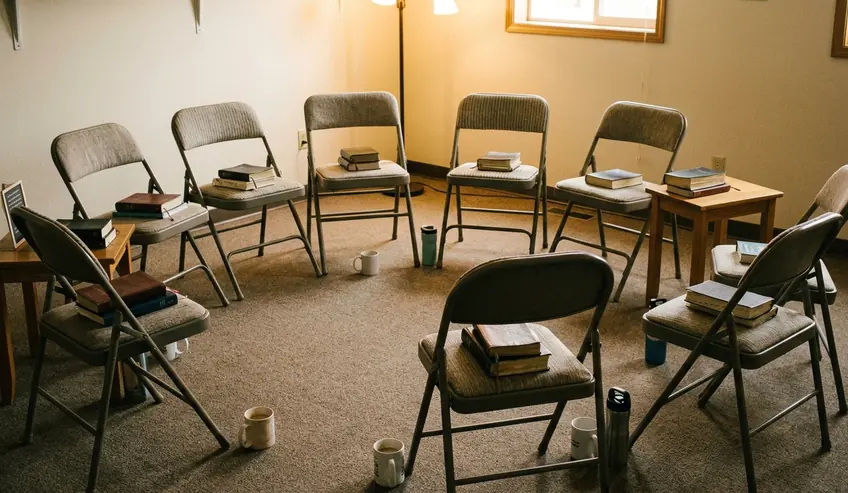
During the final 30 minutes, the large room divides by age band and gender into smaller clusters of 5 to 10 students paired with adult leaders. Leaders guide the conversation using 3 to 5 open-ended questions prepared in advance. Unlike school quizzes or reading-comprehension drills with hidden "right" or "wrong" answers, these prompts ask students what they noticed in the passage, where they see similar tensions at school, and how they handle those moments.
While these circles foster deep trust, parents should understand the exact scope of our volunteer leadership. Breakout leaders serve as spiritual mentors and caring adults; they are equipped to listen, pray, and point students toward Scripture, and they are not licensed clinical counselors. Because volunteer mentors do not diagnose or treat mental health conditions, a teenager working through clinical anxiety, an eating disorder, or deep trauma will need a licensed professional walking alongside the group rather than using church attendance in place of clinical care. When a student raises signs of severe depression, self-harm, abuse, or substance use during a breakout, leaders follow an immediate referral path: notifying the youth pastor first, engaging the parent or guardian where appropriate, and connecting the family with professional care. For urgent situations, the national 988 Suicide & Crisis Lifeline (reached by calling or texting 988) stands as our immediate crisis resource.
Adult Leader Screening, Two-Leader Rules, and Physical Boundaries
Handing over care of a middle or high schooler requires more than good intentions; it demands verifiable institutional safeguards. Operating within a conservative Assemblies of God ministry framework—shaped by national Assemblies of God youth ministry resources and local church governance—every adult volunteer passes through a multi-stage vetting sequence before stepping into a youth room.
Drawing on our church's six-month congregation attendance requirement for prospective volunteers, leadership ensures that no stranger walks off the street and into a mentoring role. From the moment a regular church attender submits a youth ministry application to their first solo-supervised night, the screening timeline spans 3 to 8 weeks. Candidates must clear a national criminal background check (which typically returns in 3 to 10 business days) and reference checks before they are even scheduled for a face-to-face pastoral interview. Only after clearing the pastoral interview do candidates enter safety training and serve their initial nights under direct veteran supervision. Background checks are then renewed every 1 to 3 years.
Wyoming is a universal mandatory reporting state under Wyo. Stat. § 14-3-205. Under state law, any person—not only licensed professionals—who knows or has reasonable cause to believe a child is being abused or neglected is legally required to report it. Every youth volunteer is trained on this legal and moral obligation before serving a single Wednesday night.
The Rule of Two and Open-Door Visibility
Physical room layout is governed by the "rule of two" visibility standard. At least two screened adults are present whenever students are in the building. No adult leader is ever alone one-on-one behind a closed door with a student. During the 30-minute breakout phase, circles meet in shared corners of the large main room, in rooms with open doors, or in spaces fitted with clear door windows so every interaction remains observable at all times.
Check-In, Dismissal, and Digital Boundaries
Supervision on meeting nights starts at door check-in, roughly 10 to 15 minutes before games begin, and ends only at parent pickup or a parent-approved dismissal arrangement—such as a high school driver who has parental permission on file. Students do not wait unattended in the dark in the parking lot after prayer wraps up; leaders remain stationed at the exits until the final car pulls away.
The same visibility standard applies to phones and social media throughout the week.
- No Private Direct Messaging: Adult leaders do not engage in private, one-on-one text threads or direct social media messages with students.
- Two-Adult Group Threads: Any digital check-in, prayer reminder, or schedule update sent via text includes a second screened adult leader or a parent on the thread.
- Curfew Hours: Ministry communication stays strictly within set daytime and early-evening hours, running from roughly 8:00 a.m. to 9:00 p.m.
Navigating Group Dynamics: How Teens Participate Without Pressure
Ask ten hesitant teenagers why they are nervous about visiting a church youth group, and something like nine of them will name the same fear: being put on the spot in front of strangers. Specifically, teens dread three moments—being forced to read aloud from a passage containing unfamiliar biblical names, being asked to pray out loud on command, or getting quizzed on theology they have never studied.
Our circles eliminate those ambushes through an explicit "pass without penalty" culture. During the opening minutes of every breakout circle, the adult leader states plainly that "pass" is a complete, respected answer. A newcomer can sit, listen, and observe for their first three or four visits—or longer, without anyone singling them out or pressuring them to speak.
Every element of the 30-minute circle is designed to give students control over how they engage:
- Opt-In Scripture Reading: Leaders never go around the circle in seating order forcing each student to read a verse. Instead, the leader asks, "Who would like to read this short section?" or reads the text aloud themselves so poor readers or nervous guests stay completely relaxed.
- Three-Way Prayer Requests: Closing prayer never requires a student to perform. Teens can speak a request aloud to the circle, write an unspoken need on an index card for the leader to read anonymously, or share a concern privately with their leader after the group dismisses—always within our open-door visibility standard.
- Personality-Matched Engagement: Participation looks different across personalities. A high-energy extrovert might captain a relay team during the 20-minute game block and jump into the first discussion question. An introverted student might play a quiet supporting role or keep score during gym games, nod along thoughtfully for somewhere around 25 minutes of the breakout circle, and offer a single sentence right before closing prayer. Both styles count as full participation.
Honoring Every Temperament: Just as 1 Corinthians 12 reminds believers that the eye cannot say to the hand, "I have no need of you," a healthy youth group does not demand that quiet observers act like loud extroverts to belong in the circle.
Parent Communication Channels and Preparing for a First Visit in Wheatland
A church youth program should reinforce family conversations rather than operating as a closed black box. To keep parents in the loop without flooding their inboxes, our communication system runs on three channels ordered by how frequently families use them:
- Recurring Master Schedules: Published at the start of each semester so families can plan around sports practices, FFA events, and family travel.
- Monthly Topic Previews: Sent out 3 to 7 days before a new month begins. These previews outline the exact Scriptures and discussion themes for the upcoming four weeks, alongside any schedule adjustments for holidays, school breaks, or Wyoming weather closures. Knowing the topic ahead of time allows a parent to ask a specific question on the drive home instead of getting a one-word shrug in response to "How was youth group?"
- Direct Leader Access: Parents have the names and contact details of their teen's specific breakout leaders so they can pass along context—such as a rough week at school or a death in the family—before the student walks through the doors.
First-Night Checklist for Wheatland Students
Preparing for a first visit takes very little gear. Here is what a student needs to know before heading to the church:
- Dress Casual for Movement: Wear everyday school clothes—jeans, hoodies, t-shirts, and sneakers suited for fellowship-hall or gym games.
- Leave the Stress Behind on Supplies: Bringing a personal Bible, notebook, and pen is great if a student already has them—but they are completely optional. We provide loaner Bibles and printed passage sheets every single week.
- Arrive 10 Minutes Early: Pulling in about 10 minutes before the official start time lets a parent meet the adult leaders at the check-in door and gives us time to pair a first-time guest with a welcoming peer before the opening game whistle blows.
Consistency in a circle like this builds remarkable weight over a teenager's middle and high school years. Under the published calendar for Platte County School District #1's four-day school week, local high schoolers spend roughly 144 days in formal classrooms across the academic year (parents can verify exact annual day counts against the district's current calendar, as schedules shift slightly year to year). Against that four-day academic backdrop, showing up for a single weekly youth night, spanning the 75-minute program and supervised check-in and pickup windows, adds roughly 60 to 100 hours of dedicated, screen-free mentorship and positive Christian peer community every year.