Spiritual growth can feel intensely personal, especially when a woman carries work deadlines, family needs, church commitments, and private questions about faith in the same week. Yet Scripture repeatedly places growth within a gathered body. Women need room to study carefully, ask honest questions, receive prayer, and practice what they have learned alongside people who know their names.
In Platte County, that conviction has shaped a practical Tuesday rhythm. The gathering offers rigorous Bible study without losing the warmth of coffee, conversation, and shared prayer. Its purpose is steady formation: helping women carry biblical truth into Wednesday morning and the rest of the week.
Why Tuesday Consistency Protects Connection
What changes when women gather every week?
The women’s ministry team reached its “weekly, not occasional” position through a simple record of participation. Across the cycles running from fall 2022 into spring 2024, the coordinator maintained a two-column roster. One column listed women attending at least three Tuesdays per month; the other listed those attending once a month or less. At the end of each nine-month ministry cycle, the team compared who remained connected.
That record moved the conversation beyond preference. A dependable weekly meeting gave relationships enough continuity for women to notice an absence, remember a prayer request, and return to a difficult passage without starting over. Occasional events still had value, but they could not carry the same pastoral and relational weight.
The roster offered a local ministry indicator rather than a measurement of inward spiritual maturity. It tracked visible connection across these particular study cycles, which made it useful for scheduling and follow-up while keeping its conclusions appropriately focused.
Isolation creates predictable pressure. A difficult Bible passage can remain unresolved. One discouraging week can quietly become a month away from Christian community, and personal interpretations may go untested by the wisdom of other believers. Consistent gathering brings those pressures into the light before they harden into withdrawal, exhaustion, or theological drift.
A durable weekly gathering gives women a place to receive truth, speak honestly, pray specifically, and carry one faithful action home.
The ministry year follows two formal cycles: early September through mid-December, followed by mid-January through late May. During the eight- to ten-week summer gap, informal porch-and-park meetups preserve relationships without pretending to be a full study program.
How the 90-Minute Gathering Works
From coffee to careful passage work
A common question from new attenders is simple: “What will we actually do for an hour and a half?” The Tuesday schedule answers that question with four fixed blocks.
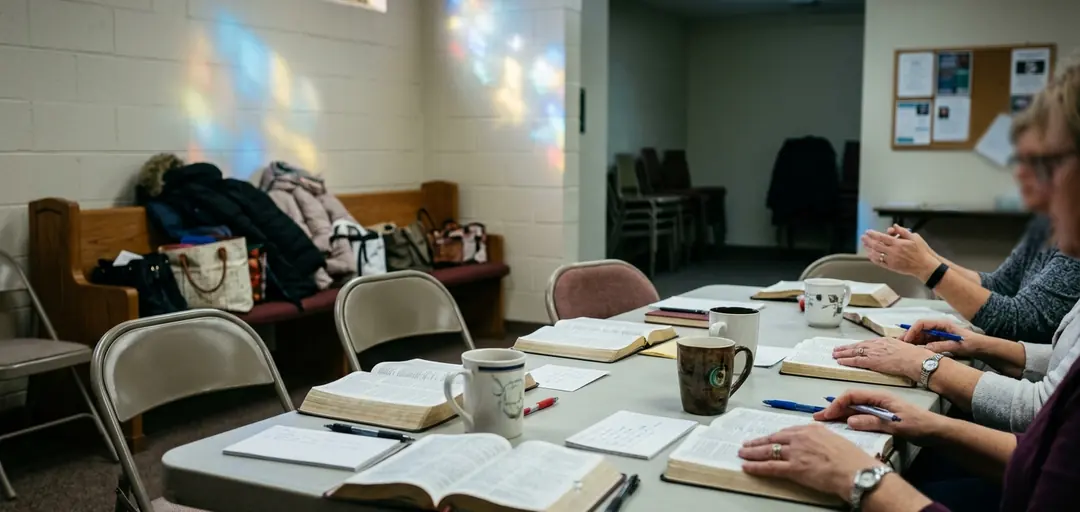
- 20 minutes of open fellowship and coffee: Women arrive, complete childcare check-in, and reconnect without forcing personal conversation into a formal lesson.
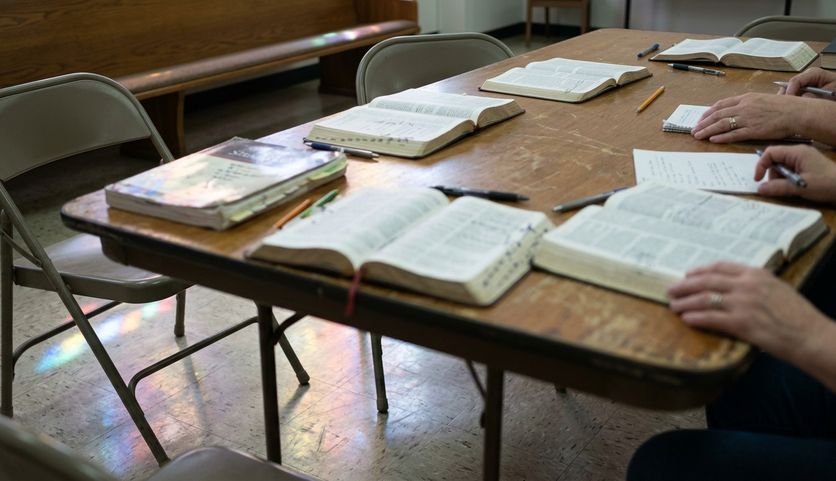
- 40 minutes of passage work: The group studies a selected text within one biblical book, paying attention to context, structure, repeated words, and the author’s argument.
- 20 minutes of guided circle discussion: Groups of five to seven work through prepared questions and test how well they have understood the passage.
- 10 minutes of intercessory prayer: Requests are written on index cards, prayed over, and redistributed the following week.
An audible transition cue keeps the opening coffee block from consuming the time reserved for exegesis. That small operational choice matters. Fellowship can easily expand when friends have much to share, while serious passage work rarely claims extra minutes on its own.
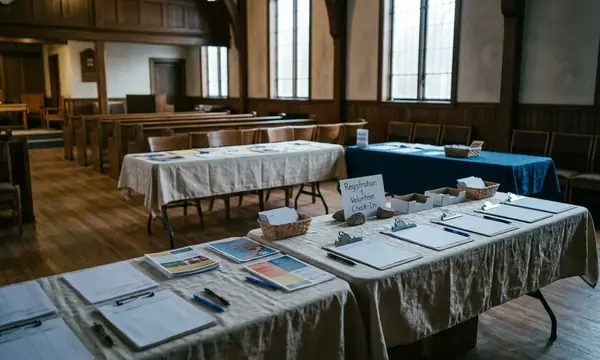
The room opens at 6:00 p.m. for early arrivals. Doors to the formal gathering run from 6:30 to 8:00 p.m., and childcare check-in closes at 6:40 p.m. Clear timing helps women coming from long commutes, school district shifts, ranch work, or hospital schedules decide what they can realistically attend.
Why the group stays in one biblical book
Each study remains in one book for six to eight weeks. A shorter epistle may receive a complete reading, while a longer narrative book is divided into a defined section. This progression teaches women to follow an argument instead of collecting disconnected verses.
The structure grew out of a concrete comparison. Leaders considered a monthly Saturday brunch, reasoning that a longer and less frequent meeting might help women driving from Chugwater or Glendo. After two trial mornings in an earlier cycle, the four-week interval required each session to rebuild context and relationships. The weekly Tuesday format gave the study enough continuity to move forward.
Guided circles also change the posture of the room. Women move from listening to articulating what a passage says, where their reading may be incomplete, and how another believer sees the text. When studying Paul the Apostle, for example, a circle can examine how 1 Corinthians 12 describes interdependence within the body and then ask whether its own habits make room for quieter members.
One Action That Changes Wednesday
Turning good notes into a lived response
The ministry once heard an honest complaint during a mid-cycle feedback night: women were leaving with good notes and no changed Wednesday. Leaders responded by adding a brief written practice before dismissal. Each woman now writes one sentence naming an action connected to that evening’s passage, then reads it aloud to her accountability partner.
The sentence must be specific enough to complete within one week. “Practice patience” leaves too much room for interpretation. A workable action might identify one strained conversation, one person to encourage, or one responsibility that needs to be completed without resentment. The biblical text supplies the reason; the written sentence defines the next step.
Platte County situations belong in the discussion
Application gains clarity when it addresses the life women actually live. A discussion prompt might ask how a passage about faithful speech applies during a hospital shift, in a school district workplace, or after a long commute home. During calving or haying season, the same passage may raise questions about exhaustion, family communication, and the temptation to treat spiritual attention as expendable.
Caregiving creates another kind of pressure. A woman helping an aging parent in the same town may have little control over her schedule. Her weekly action could be small enough to carry into a waiting room or a hurried evening meal. Faithfulness becomes concrete through the next obedient step, even when that step fits into one sentence.
- Tie the action directly to the passage rather than to a general self-improvement goal.
- Name a person, setting, or decision where possible.
- Choose an action that can be completed or assessed before the next Tuesday meeting.
- Tell an accountability partner what support would help.
Accountability that fits into an ordinary week
Pairs remain together for a six- to eight-week cycle and rotate at the halfway point. Between Thursday and Saturday, each partner initiates a check-in. A text message counts. One sentence is enough.
This low threshold serves an important purpose. Accountability should make obedience more visible without creating another heavy assignment. A brief message such as “I made the call we discussed” can close the gap between intention and action. If the step stalled, the partner can ask a focused question, pray, and help reduce an oversized goal to something honest and attainable.
Write Wednesday’s Step
Before leaving on Tuesday, finish this sentence: Because this passage says ______, I will ______ before we meet again.
A Grace Lane for Grief, Work, and Family Strain
Participation can change without severing belonging
Weekly consistency gives the ministry its anchor, yet attendance cannot become a test of spiritual worth. Grief, relocation, caregiving, health concerns, seasonal agricultural work, and family disruption can sharply reduce a woman’s capacity. A faithful ministry names those realities before someone feels compelled to disappear.
Leaders developed the Platte County “grace lane” after noticing a recurring pattern: women apologized for missing meetings and then stopped returning. The team replaced the unspoken expectation with three named participation levels, explained aloud on the first night of every cycle:
- Full participation: Regular attendance, study involvement, and normal communication with the group.
- Prayer-list-only participation: The woman’s name remains on the roster, but the ministry places no attendance expectation on her.
- A defined pause: A four- to twelve-week break that ends with exactly one call from the coordinator.
Moving to a lighter tier is a responsible decision when capacity changes. The single-call limit also protects a woman in grief or crisis from repeated contact that may feel like pressure. She knows the group remembers her, and she retains room to respond when ready.
Grace requires enough leaders to remember names
This model has an operational boundary. It works while one coordinator personally knows every woman on the roster. Once regular attendance moves past roughly twenty-five, one volunteer can no longer carry careful follow-up without absences becoming invisible. The ministry’s plan at that point is to form two evening groups.
Leadership roles carry similar flexibility. Facilitators commit for one cycle and may hand off at the midpoint. A replacement co-leader shadows for two to three weeks before guiding a session alone. That overlap protects the quality of the study while allowing a leader to step back during a demanding season.
Choose Your Lane
If full participation is beyond your present capacity, ask to remain on the prayer list or set a defined pause. Staying named within the community is a meaningful form of connection.
From First-Century Homes to Platte County Tuesdays
Why the opening night begins in Acts
New attenders sometimes describe a women’s gathering as one optional program among several weeknight choices. The ministry addresses that assumption during the first session of each cycle by examining the assembly pattern of the early church.
The opening study follows the Acts accounts of believers meeting daily in the temple courts and from house to house. It then turns to household-assembly greetings in the epistles. Across those texts, gathered life appears as a working mechanism for teaching, prayer, shared care, and endurance in a hostile culture.
Those believers needed one another for more than an encouraging event. Gathering helped them preserve apostolic teaching, recognize material needs, carry burdens, and remain identifiable as a people shaped by Jesus. Paul the Apostle’s picture in 1 Corinthians 12 reinforces the same reality: each member belongs to a body whose parts depend on one another.
A household-sized picture of endurance
First-century house assemblies may have held somewhere around twenty to forty people. The teaching team draws attention to that range because it resembles the capacity of the fellowship room. The comparison puts church history within reach: a modest room filled with known faces can sustain serious scriptural learning, practical care, and courageous faith.
Modern women do not share every pressure faced by the earliest congregations. They do share the human need for truth remembered together and burdens carried by name. Tuesday evening continues that ancient pattern through coffee, passage work, honest discussion, and index-card prayer.
The Acts gatherings and household greetings in the epistles cover roughly three decades of the church’s earliest life; in Platte County, that enduring pattern is practiced in one focused, 90-minute Tuesday gathering.