Sorting the Midnight Crisis from the Step Study Question
Who exactly do you call when you face a crisis at 2:00 AM versus when you need guidance on a specific recovery step? Sort the need before you dial. A 2:00 AM craving in a truck outside the Platte County liquor store goes to the accountability partner. A stuck Step 4 inventory column goes to the sponsor. The raw week you cannot summarize goes to the Friday 8:00 PM open share chair. These are three distinct doors within one ministry, and knowing where the boundaries sit keeps helpers from burning out while getting people the right kind of help when they need it.
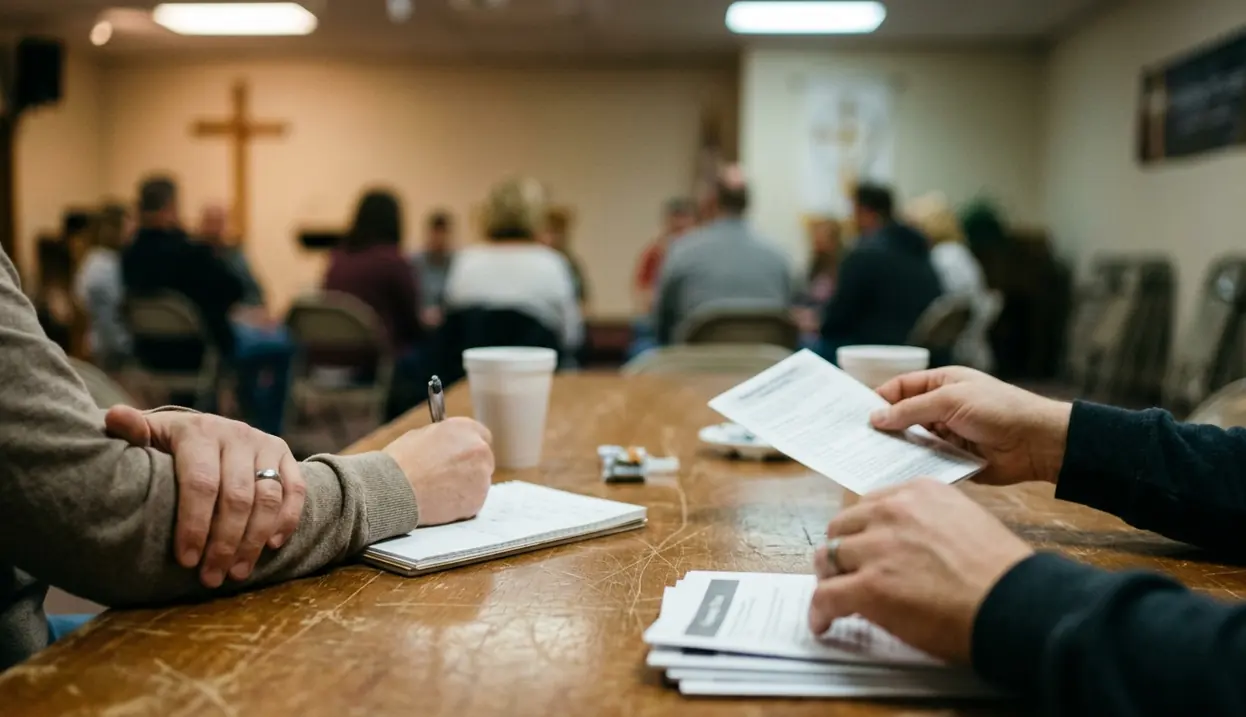
The Friday night structure in Wheatland provides a clear rhythm for this support. We start with a shared meal at 6:00 PM, move to large group teaching or testimony from 7:00 to 8:00 PM, break into gender-specific open share groups from 8:00 to 9:00 PM, and finish with informal coffee fellowship until roughly 9:45 PM. Each of these four windows answers a different kind of need. Newcomers are asked to commit to attending eight consecutive Friday nights. That two-month window gives you time to evaluate whether the Celebrate Recovery framework fits your life.
Guiding the Curriculum Through Lived Experience
A sponsor serves as a structured guide through the recovery process. They have completed all four participant guides of a full step study and are actively working the principles in their own lives. Their primary function involves walking a sponsee through the curriculum, answering framework questions, and providing spiritual direction based on lived experience.
Sponsor-sponsee step-work calls happen at a fixed weekly time of 45 to 60 minutes. The sponsee is expected to have written homework completed beforehand. Most sponsors carry no more than two or three sponsees at once to maintain focus.

The sponsor's authority ends at the last page of the fourth participant guide. They provide structured mentorship, not rent money, medical diagnoses, or legal advice. Driving someone to a court date falls outside the role as well. A sponsor is a guide through the steps, leaving professional therapy and financial advising to qualified experts.
Daily Peer Encouragement and Immediate Contact
We watched experienced guides burn out and step back entirely when they tried to absorb daily contact volume on top of weekly step work. Carrying three sponsees plus nightly check-in texts simply collapsed the role. The solution was splitting frequency from authority.
Just as Paul the Apostle described the body of Christ in 1 Corinthians 12, every member plays a distinct, necessary part. An accountability partner is a peer walking alongside you in the recovery journey. This is a mutual relationship focused on daily encouragement. The standard agreement involves a daily check-in text or call at an agreed time, most commonly between 7:00 and 9:00 PM. It includes standing permission to call at any hour during an acute craving or crisis.
Partners revisit and renew the arrangement about every three months, with an explicit no-fault option to end it. Failing pairings dissolve cleanly, allowing both people to find a better fit for sharing immediate burdens.
Protecting the Friday Night Open Share Room
When a group regularly exceeds a dozen people, the sharing time per person compresses. Participants begin giving safe summaries instead of honest disclosures. Open share groups are kept to roughly six to twelve participants to maintain a safe space for weekly sharing.
Sharing turns are held to three to five minutes each using a visible timer. Every meeting opens with the same read-aloud guidelines, which take about four minutes. These five guidelines cover gender-specific sharing, no cross-talk, no fixing or advising, anonymity, and no profanity or graphic detail. They are read at the start of every weekly meeting through the year, holiday weeks included. The "no cross-talk" rule means every participant can share their experiences without interruption or unsolicited advice.
One boundary requires clear definition. The confidentiality promise covers what people choose to disclose about their own struggles, and it stops where Wyoming mandatory-reporting duties begin. Disclosure of child or elder abuse, or a credible threat of harm to oneself or another person, will be reported and acted on by leadership. Anyone who needs privileged, legally protected conversation should be working with a licensed counselor. Pastoral staff like Jeremy Haroldson will help make that referral.
Building Your Network Before You Need It
Do not wait until you find the perfect sponsor to start building your recovery network. Based on what our leaders have seen, waiting for an ideal match can cost a participant something like four to six months of unstarted step work. New step studies in Wheatland launch two to three times per year, and choosing a sponsor is typically encouraged after a month or two of consistent attendance.
Begin immediately by committing to a weekly small group. Leave your first Friday with one phone number and make contact with that person before the next meeting. Treat this as a strict seven-day turnaround. Action builds momentum.
Applying 1 Corinthians 12 Every member plays a distinct, necessary part in your recovery network. Secure your accountability partner this week and start making the daily calls.